


The Chinese artificial intelligence startup,DeepSeek, drew global attention in November 2024 with its R1 AI model. The same company has now introduced a new training architecture designed to make large language model(LLM) development more efficient and reliable.
The Chinese artificial intelligence startup DeepSeek gained global attention in November 2024 with its R1 AI model. The company has now introduced a new AI training architecture aimed at making large language model (LLM) development more stable and efficient.
In a recently published research paper, DeepSeek detailed an approach called Manifold-Constrained Hyper-Connections (mHC), designed to reduce training instability — a key challenge that often leads to failed runs and wasted computing resources in large AI models.
DeepSeek’s New AI Training Architecture Explained
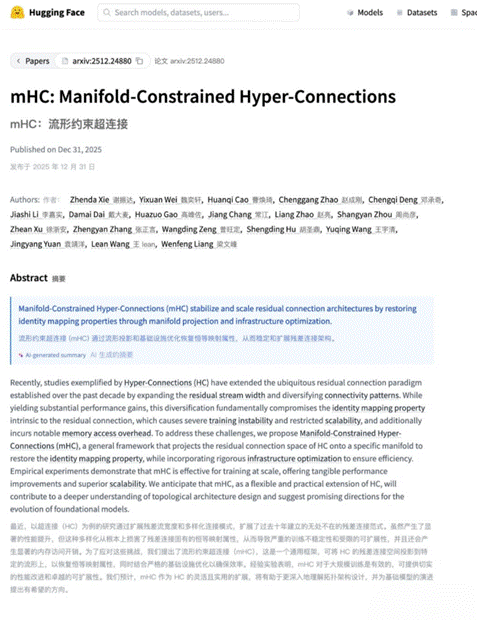
The research paper, published on arXiv and listed on Hugging Face, explains how the mHC architecture changes the way neural network layers communicate during training. According to DeepSeek’s researchers, the method restructures shortcut connections within models to better control how information flows across layers.
Large AI models rely on shortcut pathways to maintain signal strength across deep networks. However, when these shortcuts expand without proper constraints, they can introduce instability and make models difficult to train end-to-end. DeepSeek’s mHC approach addresses this by projecting these connections onto a mathematically defined structure known as a manifold, helping keep signals stable during training.
Why mHC Matters for AI Training
Training modern AI models involves adjusting billions of parameters, which is why identical prompts can produce slightly different responses across platforms such as ChatGPT, Gemini, or Claude. When signals inside a model become too strong or fade too quickly, training can fail midway, forcing developers to restart the process.
The mHC design aims to prevent this by keeping shortcut connections predictable and mathematically controlled, reducing the risk of training interruptions.
Tested Across Multiple Model Sizes
DeepSeek tested the new architecture across models of different sizes, including a 27-billion-parameter model, along with smaller variants. The results showed that the mHC architecture helps maintain stability and scalability even in large models, without adding significant computational overhead.
While the approach does not directly reduce hardware power consumption, it can lower overall compute and energy usage by minimising failed training runs.
Real-World Adoption Yet to Begin
So far, the mHC architecture has not been integrated into commercial AI models, making its real-world impact difficult to measure. However, the approach presents a promising alternative to existing training techniques. Its broader significance will become clearer as independent researchers test the architecture and publish comparative results.
